Using Are You Alive? While Traveling
Everything you need to know about staying safe and connected on the road.
Before You Leave
Download and Set Up
Get the app from your app store and create your account before you leave home.
Add Emergency Contacts
Add family members who should be notified if you go silent. Include at least one person who could contact local authorities.
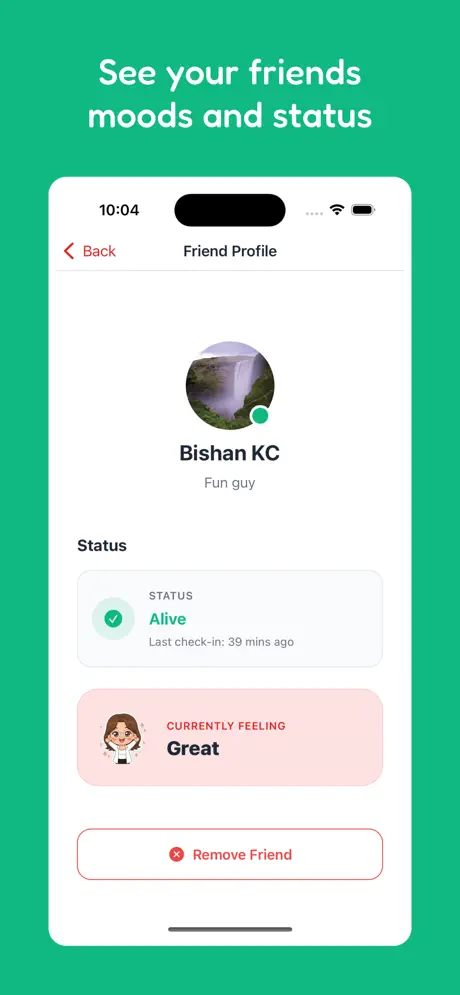
Connect Family as Friends
Add family members as friends so they can see your daily status without you texting them individually.
Configure Alert Delay
Set your emergency alert delay. 1 day for high-risk travel, 2-3 days if you might be offline.
Daily Travel Routine
Build the check-in into your daily travel rhythm:
- Morning hostel/hotel WiFi: Check in before you head out for the day
- Cafe first stop: Many travelers check in when they sit down for morning coffee
- Before bed: If mornings are hectic, check in at night instead
Consistency Over Perfection
Pick ONE time that works for your travel style and stick with it. The habit matters more than the specific time. Morning is ideal because it gives you the most time to catch it if you forget.
Handling Low Connectivity
Not everywhere has reliable internet. Here's how to handle it:
- Priority WiFi spots: Check in when you find WiFi—cafes, hotels, airports
- Set longer delays: If traveling remote areas, use 2-3 day emergency delay
- Pre-communicate: Tell emergency contacts before going off-grid
- First thing when connected: Make check-in your priority when you get WiFi
Multi-Day Treks and Remote Areas
Going off-grid for hiking, trekking, or remote travel?
- Before departure: Check in and message contacts about your plans
- Set delay to maximum: 3 days protects against false alarms
- Tell people your return date: Emergency contacts should know when to expect you back
- Immediate check-in on return: First thing when you get signal/WiFi
Timezone Considerations
Crossing timezones? The app uses 24-hour rolling windows:
- Check in once per calendar day (your local time)
- The app tracks 24 hours from your last check-in
- If you land somewhere with a big timezone jump, check in after landing
- Your streak won't break from timezone travel if you check in daily
Traveling with Others
Traveling with friends? Here's how to coordinate:
- Add each other as friends: See each other's status
- Daily group accountability: Everyone checks in to the same routine
- Emergency contacts: Add each other's family as emergency contacts
- Splitting up: When you separate, you're both still visible to family
The Traveler's Paradox: Freedom vs. Security
Every traveler knows the feeling: the exhilarating sense of total freedom as you step off a plane in a new country. But that freedom often comes at the cost of your usual security structures. Back home, friends know if you don't show up for work. Neighbors see your lights go on and off. On the road, you are essentially "off the grid" to everyone who knows you.
Are You Alive? was built to bridge this gap without sacrificing the very freedom you're traveling for. It provides a "minimum viable safety net" that stays in the background, only surfacing if something goes wrong. It's the digital version of a "safe travels" wish from a loved one—a silent guardian that lets you focus on the adventure while keeping your family at ease.

Safety shouldn't cost you your freedom.
The Importance of the 'Digital Standup'
In the business world, a "standup" is a quick daily meeting to ensure everyone is on the same page. For a solo traveler, the "Are You Alive?" check-in is your "Digital Standup." It's a 30-second ritual that confirms to your global support network that you are ready for the day.
This ritual is especially important when you’re moving between hostels or cities. By checking in before you leave one secure location (like a hotel with WiFi) and after you arrive at the next, you create a "success trail" that can be invaluable if you ever miss a scheduled check-in.
Connectivity Strategies for the Modern Explorer
We know that internet access can be patchy in many parts of the world. Here are our top tips for staying connected without the stress:
The 'Morning habitual' WiFi
Most hostel and hotel common areas have the strongest signal in the morning. Make check-in your first act while the bandwidth is high.
Offline Preparedness
If you're heading into a "dead zone" (like a long bus ride), check in early. Don't wait until you're already out of signal.
The eSIM Advantage
Consider using global eSIMs like Airalo or Holafly. Having consistent data is the ultimate safety feature for solo travelers.
Low-Tech Backup: Communicating Your Itinerary
While Are You Alive? handles the "are you okay" check, it works best when paired with a low-tech itinerary share. Before you head to a new region, share a quick note with your primary emergency contact: "Heading to the Gili Islands for 3 days. Might be offline, I've set my alert delay to 3 days. Talk soon!"
This context is critical. If your alert *does* go off, your family won't just see a generic warning; they'll know exactly where to start their search. This combination of automated check-ins and human context is the gold standard for travel safety.

Building a global community of safe travelers.
Case Study: Peace of Mind in Bali
"I was staying in a remote village in Bali," says Elena, a solo backpacker. "The power went out for 18 hours. Because I had set my Are You Alive? delay to 48 hours before I left the city, my parents didn't panic when they didn't hear from me for a day. When the power came back, I checked in immediately. The app prevented a massive, unnecessary family international crisis. It let me just be in the moment."
The Future of Travel Safety: A Global Network of Care
We are moving toward a world where "solo travel" doesn't have to mean "traveling alone." By using status-based safety tools like Are You Alive?, you are helping to normalize a culture of proactive care.
Our long-term goal is to build a platform that goes beyond simple check-ins, integrating with local safety resources and community groups. But it all starts with the simplest possible act: one tap to say you're okay. We're proud to be part of your adventure.