Are You Alive? vs Life Alert
Two different approaches to elderly safety: prevention vs. emergency response.
Quick Summary
Choose Are You Alive? If:
- You want daily visibility into wellbeing
- Cost is a concern (free vs $50+/month)
- Your parent is tech-comfortable
- You want awareness, not just emergency response
Choose Life Alert If:
- You need immediate emergency response
- Fall detection is critical
- Your parent can't use a smartphone
- 24/7 monitoring center is needed
Feature-by-Feature Comparison
| Feature | Are You Alive? | Life Alert |
|---|---|---|
| Monthly Cost | Free | $49.95+/month |
| Equipment Cost | None (smartphone app) | $95+ installation |
| Contract Length | None | Often 3-year contracts |
| Type | Daily awareness | Emergency response |
| Fall Detection | No (not emergency device) | Yes (pendant sensor) |
| Daily Check-In | Yes | No |
| Family Visibility | All family can see status | Emergency contacts only |
| Stigma | Looks like regular app | Medical device appearance |
| 24/7 Monitoring | No (family-based alerts) | Yes (call center) |
The Fundamental Difference
Life Alert is reactive. It waits for an emergency (like a fall) and then responds. You press a button when something goes wrong.
Are You Alive? is proactive. It provides daily visibility so you know your parent is okay BEFORE there's an emergency. No news is good news—until there's no check-in for days.
These tools can actually work together. Use Are You Alive? for daily peace of mind, and Life Alert for immediate emergency response if your parent truly needs 24/7 medical intervention capability.
Cost Comparison
Are You Alive?
Total cost of ownership
- Free app download
- No subscription
- No equipment
- No contracts
- Cancel anytime
Life Alert
Typical annual cost
- $49.95-79.95/month
- + $95 activation
- + Equipment deposits
- + 3-year contract typical
- + Early cancellation fees
The math: Over 5 years, Life Alert costs approximately $3,000-4,500 while Are You Alive? remains completely free. For many families, the daily check-in approach provides adequate peace of mind at a fraction of the cost.
Our Verdict
For most families, Are You Alive? is sufficient.If your parent is mobile, cognitively sharp, and can use a smartphone, daily check-ins provide peace of mind without the monthly expense and medical device stigma.
Life Alert makes sense if: Your parent has serious fall risk, lives in a remote area without nearby family, or requires 24/7 professional monitoring due to medical conditions.
Many families use both: Are You Alive? for daily awareness (free), and a medical alert for true emergencies (if clinically indicated).
The Stigma of the "Pendant": A Modern Shift
For decades, the image of elderly safety has been defined by the "I've fallen and I can't get up" commercial. While effective as marketing, it created a significant stigma. Many seniors refuse to wear medical alert pendants because they feel it marks them as "frail" or "dependent." This often leads to the pendant being left on the nightstand—exactly where it's useless during a fall.
**Are You Alive?** takes a different approach. It lives on a smartphone—a device that most seniors in 2026 already use for photos, news, and family chat. Using a regular app feels like a normal part of a digital life, not a medical necessity. This higher "social acceptance" means higher compliance and, ultimately, better safety.

Safety feels better when it's integrated into daily life, not just emergencies.
Reactive Response vs. Proactive Awareness
Life Alert is a "Reactive" system. It is designed for the moment *after* a catastrophe has occurred. While crucial, it doesn't address the 99.9% of the time when things are going well, but family members are still worrying.
**Are You Alive?** is a "Proactive Awareness" system. By establishing a daily ritual of checking in, you create a baseline of visibility. You know your parent is okay at 9:00 AM because they told you so. This constant, low-stakes confirmation significantly reduces "caregiver anxiety" and provides a much more holistic view of a senior's wellbeing.
The Cost of Isolation: Beyond the Subscription Fee
Traditional medical alert systems can sometimes contribute to a senior's sense of isolation. They are transactional—you pay a company to watch over your parent. This can occasionally replace the natural check-ins that would otherwise happen between family members.
**Are You Alive?** is built on community. Your "Friends" are usually your family, neighbors, or close companions. When you check in, they see it. When you forget, *they* are the ones who get notified. This strengthens the social safety net and ensures that safety remains a human, community effort rather than a corporate service.
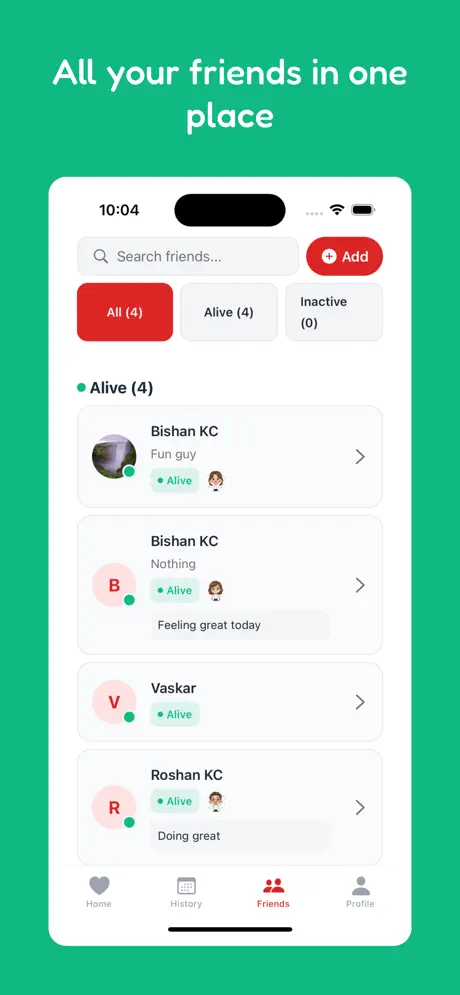
The best safety system is a group of people who care about you.
Tech Literacy in 2026: Why Seniors are Switching to Apps
The "Seniors can't use tech" myth has been thoroughly debunked. The current generation of retirees is the one that built the internet and used smartphones for the last 15 years. They find app interfaces intuitive and often prefer them to clunky hardware boxes and dedicated phone lines required by older Life Alert models.
A smartphone app like **Are You Alive?** goes where the senior goes. Whether they are at home, visiting a friend, or traveling, their safety net is always in their pocket. Traditional systems are often limited by the range of the home base station, creating a "safe zone" that ends at the front door.
When to Use Both: A Hybrid Safety Strategy
We often tell families that these two products don't have to be mutually exclusive. If a senior has a high medical risk (uncontrolled heart condition, frequent fainting), a professional-grade medical alert with 24/7 monitoring is a wise investment.
However, even in those cases, **Are You Alive?** adds value. It provides the daily accountability that Life Alert lacks. Many families use our app as the primary "I'm okay" tool and keep the medical alert as a secondary, emergency-only fallback.
The Ethics of Aging in Place
Aging in place is about maintaining dignity and independence as long as possible. Forcing a loved one to pay high monthly fees and wear a medical device can feel like an affront to that independence. **Are You Alive?** honors the senior's autonomy. It's an agreement between adults to keep each other updated—a digital version of "call me when you get home."
Final Verdict: A Question of Daily Visibility
Life Alert is for the "Oh No!" moments. **Are You Alive?** is for all the "I'm okay" moments that happen in between. For the vast majority of active seniors, the daily awareness provided by our free app is the perfect balance of safety, privacy, and cost-effectiveness.