Are You Alive? vs Find My Friends
Daily wellness check-in vs. real-time location tracking.
Quick Summary
Choose Are You Alive? If:
- Privacy matters—no location tracking
- You want daily accountability, not surveillance
- Emergency alerts after missed check-ins
- Cross-platform (iOS + Android)
Choose Find My Friends If:
- You need real-time location
- Everyone uses Apple devices
- You want to see where people are right now
- Finding lost devices is important
Feature-by-Feature Comparison
| Feature | Are You Alive? | Find My Friends |
|---|---|---|
| Price | Free | Free (Apple devices) |
| Platform | iOS + Android | Apple only |
| Location Tracking | None | Constant real-time GPS |
| Privacy | High | Low (exact location visible) |
| Emergency Alerts | Yes (email after 1-3 days) | No |
| Streak Tracking | Yes | No |
| Battery Usage | Minimal | Higher (GPS drain) |
| Best For | Daily accountability | Real-time location needs |
The Privacy Difference
Find My Friends (now "Find My") shows your exact location in real-time. Everyone in your circle can see exactly where you are at any moment—your home, your gym, your therapist's office, everywhere.
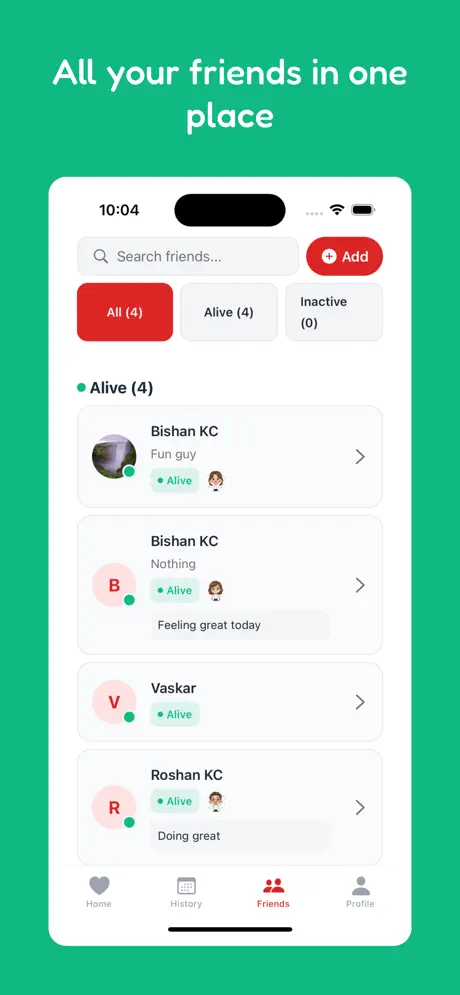
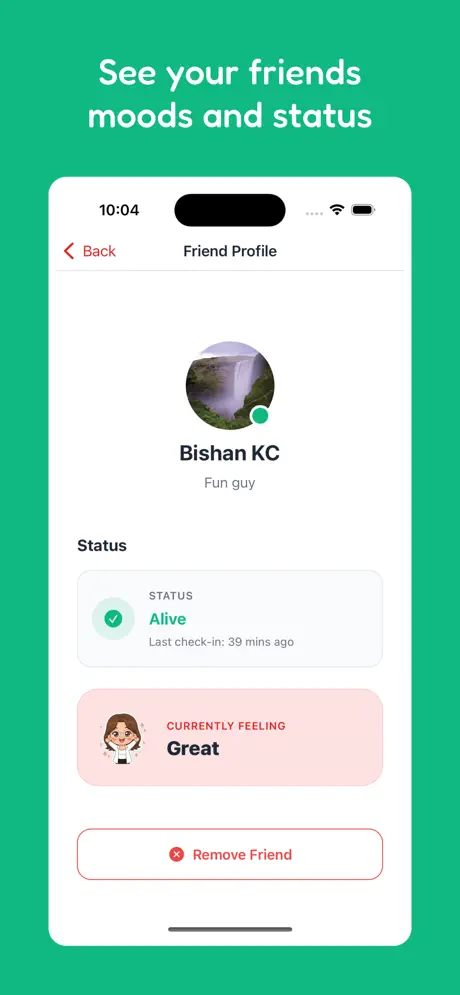
Are You Alive? shares nothing about your location. It only shows whether you've checked in today. Your friends know you're okay, but not where you are.
This is the fundamental difference: Find My is for where someone is. Are You Alive? is for whether someone is okay. Different tools for different purposes.
Use Case Differences
Find My Friends is better for:
- Meeting up with friends ("Where are you?")
- Tracking young children's location
- Finding lost Apple devices
- Real-time ETA when traveling to meet someone
Are You Alive? is better for:
- Daily peace of mind for family
- Adults who value privacy but want accountability
- Emergency alerts when someone goes silent
- Building healthy daily routines with streaks
Our Verdict
These apps solve different problems. If you need to know where someone is right now, use Find My. If you want daily peace of mind that someone is okay—without tracking their every move—use Are You Alive?
Many people use both: Find My for immediate location needs with close family, and Are You Alive? for daily visibility with a wider circle who doesn't need GPS access.
The Illusion of Safety: Why Real-Time Tracking Can Be Deceptive
Find My Friends (and the broader Find My ecosystem) is a technical marvel. It allows you to see the exact street address of your loved ones at any moment. This creates an immediate feeling of safety, but it's often an illusion. Just because you know where someone is doesn't mean you know they are *okay*. A phone can be at a park while its owner is in distress elsewhere, or a phone can be "stuck" at a location due to poor signal, causing unnecessary panic.
**Are You Alive?** focuses on the *user's status*, not their coordinates. By requiring a daily manual check-in, we provide proof of life and agency. This is a much more reliable indicator of wellbeing than a passive GPS dot on a map.
Privacy is the foundation of digital trust.
Privacy by Design: Why We Don't Want Your GPS Coordinates
The "Find My" service is arguably one of the most invasive mainstream technologies. While Apple is better than most at protecting this data, the fact remains that your entire movement history is being tracked and stored. For adults, this can feel like a violation of the "right to be left alone."
**Are You Alive?** was built with a different philosophy: we don't want to know your business. We don't collect location data because we don't need it. We only want to know that you are alive and well. This "Minimal Data Footprint" is better for your privacy, your peace of mind, and the security of your information.
Battery Life and Resource Usage: The Impact of Continuous Tracking
Continuous GPS tracking is one of the most power-hungry features on any smartphone. Find My and similar apps can significantly drain a battery, especially in areas with poor satellite visibility where the device has to "hunt" for a location.
Because **Are You Alive?** only requires a few seconds of activity once a day, its impact on your battery is effectively non-existent. This ensures that your phone stays charged longer, providing more reliability for actual emergency communication when you truly need it.
Safety through accountability, not constant monitoring.
Cross-Platform Reliability: iOS vs. Android Challenges
Find My is an Apple-only feature. If your family has a mix of iPhones and Android devices, it becomes a fragmented and frustrating experience. Third-party trackers like Google Maps or Life360 attempt to bridge the gap, but they often struggle with background permissions and battery optimization.
**Are You Alive?** is built to be truly cross-platform. Whether you're on a Samsung, a Pixel, or an iPhone, the experience is identical. This makes it the ideal tool for diverse families and friend groups who want a unified safety solution without being locked into a single ecosystem.
The "Lag" Advantage: Reducing Anxiety for Caregivers
Real-time tracking often increases anxiety rather than reducing it. Parents find themselves constantly checking the app, wondering why their child is "stopped" at a certain intersection or why their spouse isn't home yet.
**Are You Alive?** introduces an intentional "lag." By focusing on daily windows, we remove the micro-anxiety of minute-by-minute tracking. We trust our users to live their lives, and we only escalate to "Friend" notifications after a significant period of silence (1-3 days). This "High-Level Awareness" is much healthier for relationships than the "Micro-surveillance" of real-time GPS.
The Long-Term Impact on Digital Wellness
Constant location tracking can have a subtle but profound impact on your relationship with your device. It makes the smartphone feel like a leash rather than a tool. By choosing **Are You Alive?**, you are reclaiming your digital agency. You are saying that your safety does not have to come at the cost of your constant surveillance. This is a vital step toward long-term digital wellness.
Conclusion: Finding the Right Balance
Safety tech should serve the user, not the other way around. While Find My Friends is an incredible piece of engineering, it is often overkill for daily safety and accountability. **Are You Alive?** provides the perfect balance: enough visibility to keep you safe, but enough privacy to keep you free.
Final Verdict: Presence vs. Positioning
Find My is for finding things—keys, AirPods, and sometimes people who are lost. **Are You Alive?** is for being present for the people you care about. If you want to know *where* someone is, use Find My. If you want to know *that* someone is okay, choose the privacy and intentionality of Are You Alive?.